

Capturing Dispersion on Quantum Computers
Published on November 12, 2026
Kvantify Research and Applications
Dispersion is ubiquitous in nature. Rainbows are a prime example: the refraction of light in water depends on the color of the light, resulting in one of nature’s most delightful shows. In general, dispersion describes how the response of a system to an electromagnetic field depends on the frequency of the field.
At the molecular level, disperson effects play a crucial role in how atoms and molecules interact. Despite being weak noncovalent interactions, dispersion effects can collectively help shape the selective binding of one molecule to another, which is crucial in many processes. In addition, dispersion interactions contribute substantially to the stability of biomolecules, including proteins and nucleic acids. In DNA and RNA, dispersion is an important component of π-stacking interactions between aromatic nucleobases, whose approximately parallel arrangement brings their π-electron systems into close proximity.
Attractive dispersive interactions arise from many-electron dynamical correlations, which are very challenging to model computationally. Gold-standard computational quantum chemistry methods such as CCSD(T) – that is, coupled cluster with single, double, and perturbative triple excitations – can capture this physics accurately at small scales, but their steep scaling with system size and orbital space makes them intractable for most systems of practical relevance.
This is exactly where quantum computing becomes interesting: it represents a potential route to high-accuracy quantum chemistry with more favorable computational scaling than classical methods.
In our latest study, we have tested how far a state-of-the-art variational quantum eigensolver (VQE) approach can go in terms of capturing dispersion in a π-stacking model. In particular, we compare noiseless simulations and real quantum hardware calculations, done on Quantinuum’s System Model H2, against CCSD(T) within matched active spaces, focusing on how efficiently the quantum approach recovers the underlying correlations. We ran the classical calculations on an NVIDIA DGX Spark, which also handles quantum circuit simulation through Qrunch’s optimized integration with NVIDIA cuTensorNet, as described in our previous blog posts on scaling Qrunch with tensor network simulation and NVIDIA DGX Spark.
A DNA-Inspired π-Stacking Model
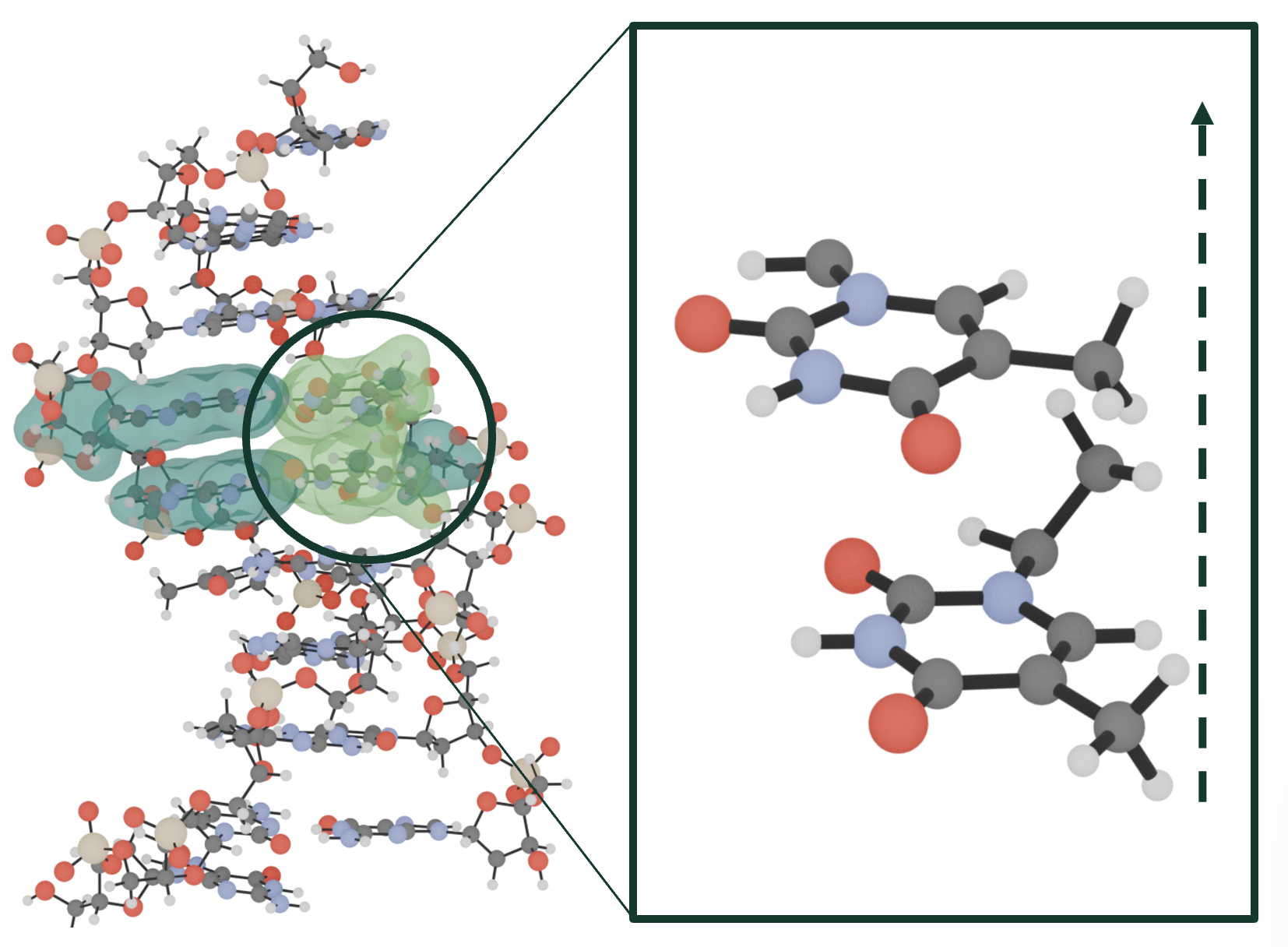
To put dispersion to the test in a realistic biomolecular case, we build a simple π-stacking model (Fig. 1) from two thymine bases extracted from an atomistic DNA structure (PDB 208D). We then gradually pull the two bases apart in 17 steps, covering thymine separations of roughly 4 to 12 ångstrøm to map out the interaction energy profile. The depth of the resulting energy minimum gives a direct measure of how strongly dispersion stabilizes the stacked pair.
We probe this profile with BEAST-VQE, using orbital optimization and a perturbative PT2 correction, and compare the results against CCSD(T) calculations defined in comparable active spaces. The active-electron count is fixed at 10, a compromise made to retain the essential dispersion physics at manageable computational cost, while the number of active orbitals is systematically increased to reveal how the interaction evolves as a larger virtual orbital space becomes available.
All calculations use the 6-31+G basis set, which was chosen as a compact basis still capable of reproducing the qualitative dispersion profile, as verified in preliminary MP2 tests. Due to the qualitative nature of these calculations, basis-set superposition errors were not taken into account.
Figure 1: DNA atomistic model (PDB 208D) used to extract the thymine dimers defining the system used for probing dispersion. The electron densities of the stacked adenine and thymine bases are shown in dark and light green, respectively, with the thymine dimer used to construct the model. The dashed line corresponds to the direction along which the dimer is pulled apart for probing dispersive intermolecular interactions.
Capturing Dispersion with Compact Active Spaces
The central question for this investigation is how much of the dispersion OO-BEAST-PT2 can recover without having to open up a huge active space. To answer this, we compare against CCSD(T), used here as the best available approximation to the corresponding CASCI solutions.
The difference is striking. In this setup, reaching an interaction minimum of roughly 1.5 mHa requires 236 active orbitals with CCSD(T), while OO-BEAST-PT2 reaches a comparable minimum with only 53 active orbitals. That is a reduction of about 180 active orbitals for essentially the same target interaction strength.
Figure 2 makes this comparison explicit, showing the noiseless OO-BEAST-PT2 interaction curve alongside two CCSD(T) results obtained with 60 and 236 active orbitals, respectively. The key message is that OO-BEAST-PT2 recovers a substantial amount of the dispersion interaction with a far more compact active space description (roughly 80% reduction), thus lowering the qubits required.
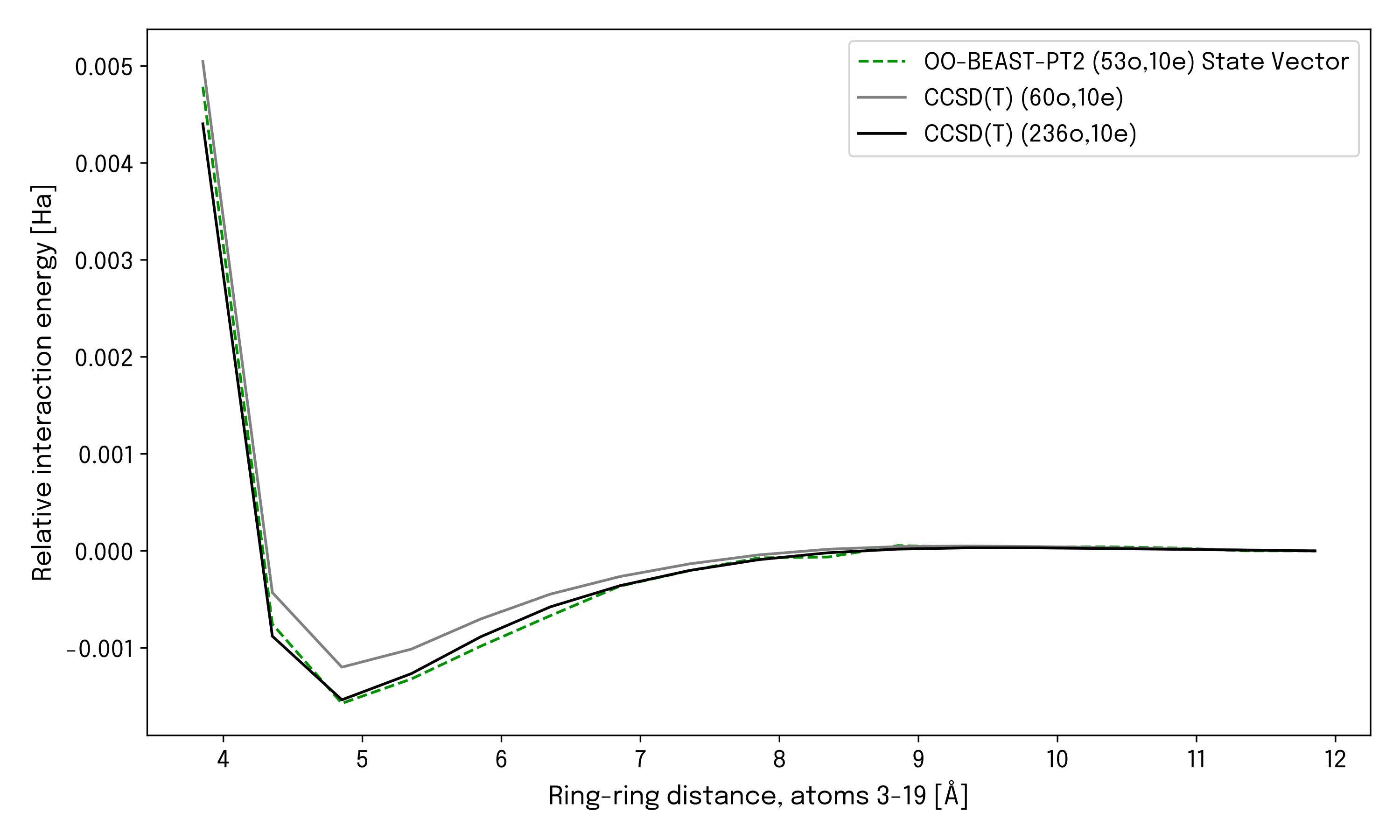
Figure 2: Relative interaction energy for the thymine dimer computed with an OO-BEAST-PT2 noiseless state vector simulation with 53 active orbitals as well as two CCSD(T) curves employing 60 and 236 orbitals, respectively.
To see whether this picture remains valid also in the case of real hardware runs, we selected two representative thymine separation geometries – the lowest-energy point and the fully dissociated dimer – and ran the corresponding quantum computations on the Quantinuum System Model H2 quantum computer. The agreement is remarkably good. As shown in Figure 3, the hardware convergence traces remain very close to the noiseless state vector results, with only minor deviations throughout the VQE optimization.
For a correlation problem as delicate as dispersion, this level of agreement is a remarkable result. It reinforces one of the key strengths of BEAST-VQE: its resilience to noise is so pronounced that it is possible to reproduce closely noiseless simulation results on physical quantum hardware.
This provides further evidence of the strong noise resilience of the BEAST-VQE approach and shows that the compact description obtained in simulation can be retained on current NISQ devices.
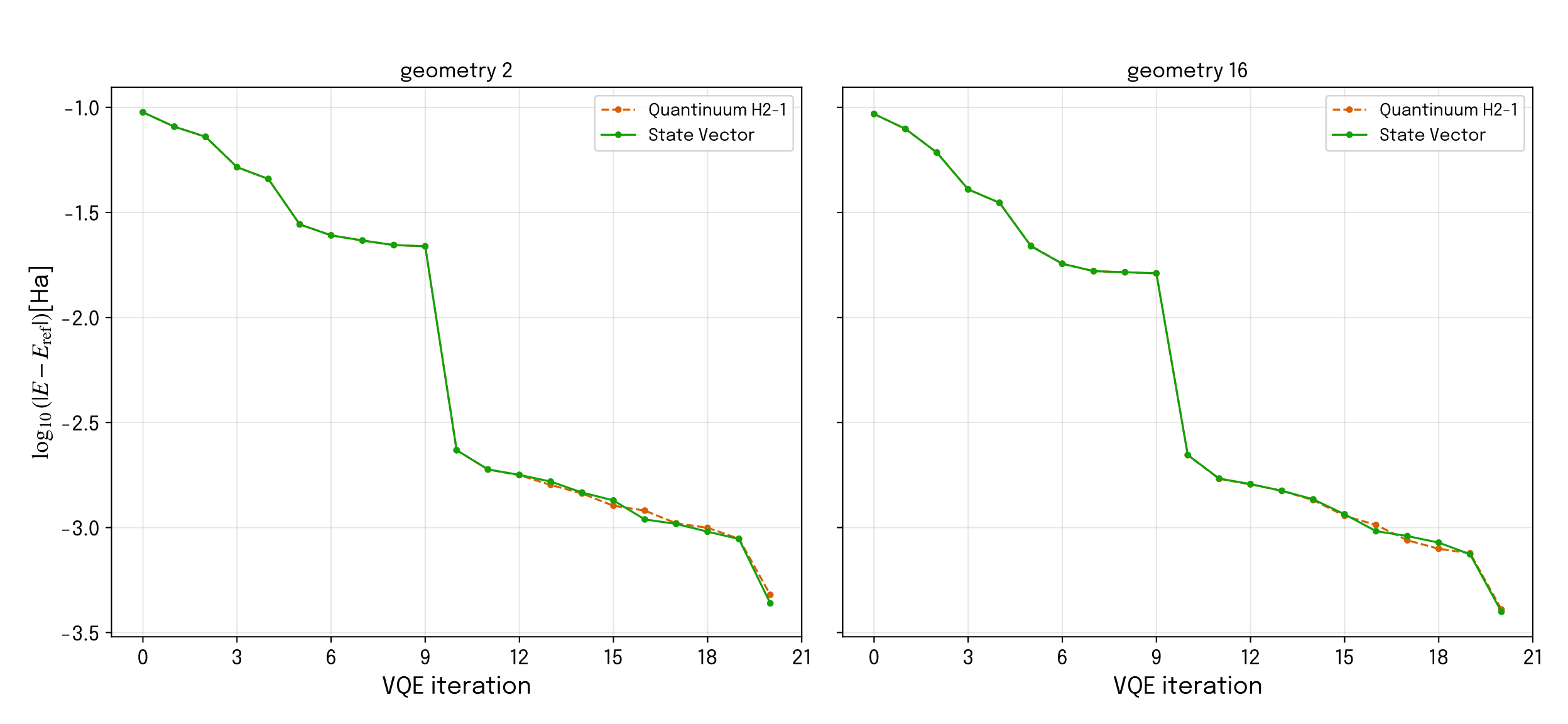
Figure 3: Convergence as a function of the number of VQE iterations for two selected geometries calculated for a noiseless state vector simulation and Quantinuum’s System Model H2 quantum hardware run. The reference energy value used in the convergence metric corresponds to the noiseless simulation at iteration 50 since the exact ground-state energy is inaccessible in the selected active space.
Taken together, these results demonstrate the potential of current quantum hardware for studying chemically relevant problems. The experiments were performed on Quantinuum’s System Model H2, which features 56 physical qubits. Their larger Helios processor, with 98 physical qubits and improved gate fidelities, is likely to be able to tackle more demanding computational tasks.
OO-BEAST-PT2 compresses the active space requirements dramatically while retaining strong robustness to hardware noise. This allows dispersion, a subtle and demanding correlation effect, to be accessed with resources that are realistic today. In that sense, the method is designed to push present-day quantum devices as far as they can reasonably go.
At the same time, this is not necessarily the algorithm we expect to use routinely once larger-scale fault-tolerant hardware becomes available. OO-BEAST-PT2 still relies substantially on classical computing, particularly orbital optimization, and those classical bottlenecks will become increasingly relevant as quantum hardware scales. As higher-quality quantum resources become available, the natural direction is to move more of the computational workload onto the quantum processor itself.
For the challenging π-stacking interaction, these results thus highlight OO-BEAST-PT2 as a promising NISQ strategy and a stepping stone towards the next generation of quantum chemistry workflows. More on that transition will follow soon in a dedicated blog post on early fault-tolerant quantum chemistry.