

Scaling Qrunch to 180-Qubit Quantum Simulations with NVIDIA cuQuantum
From NVIDIA DGX Spark to the Gefion Supercomputer: Building the Speed and Scale for Drug Discovery Applications

Published on October 21, 2026
Kvantify Research and Applications
At Kvantify, we develop applications enabled by quantum computing for drug discovery. Although our quantum engine Qrunch supports execution across major quantum hardware platforms, simulated quantum computing currently drives much of our algorithm and application development. It gives us and our customers the molecular scale and turnaround needed to develop these applications today, while quantum hardware becomes more capable and cost-effective.
Earlier this year, we described how integrating NVIDIA-accelerated computing significantly increased the achievable simulation scale in Qrunch. With the goal of supporting calculations at the full molecular scale of modern small molecule drugs, we chose the iconic penicillin molecule as a benchmark to guide our development.
In this follow-up, we extend our ground-state energy calculations for penicillin V to 180 qubits, encompassing 180 of the molecule’s 184 electrons in the active space. Reaching this scale takes us beyond a single workstation and onto the Gefion supercomputer, building on the workflow we originally developed on NVIDIA DGX Spark. On Gefion we experiment with full 180-qubit ground-state energy calculations and demonstrate near-ideal strong scaling up to 64 NVIDIA H100 GPUs, for the size of quantum circuit that necessitates a transition from workstation to HPC.
Simulating Quantum Circuits with Tensor Networks
Storing the full quantum state quickly becomes impractical, since every additional qubit doubles the number of amplitudes. Tensor networks represent a circuit as connected tensors, which we combine, or contract, to calculate quantities such as a molecular energy. By exploiting the structure of our chemistry circuits, this can greatly reduce the memory and computation required.
We perform these contractions on GPUs using cuTensorNet, part of NVIDIA cuQuantum. The order in which we combine the tensors, known as the contraction path, can make a vast difference to the work and memory required. Finding the best path is itself difficult, so cuTensorNet uses randomized heuristic searches. These can find different paths on separate runs of the same circuit. We therefore have to balance the cost of searching for a better path against the resulting reduction in execution time.
For a known path, cuTensorNet runs an autotuning step to select efficient GPU kernels. Autotuning usually accounts for about 80% of the combined path-finding and autotuning time in our runs. Because BEAST-VQE builds a new circuit at every iteration, this preparation repeats throughout the calculation.
The contraction can be split into independent slices for different GPUs to process in parallel, before combining their results into an energy estimate. We contract without tensor-network truncation, so the circuit simulation is exact to the chosen floating-point precision.
Supporting the Chemist’s Workflow from Early Experiments to Larger Active Spaces
Developing a chemistry use case means repeatedly trying ideas, checking results, and refining the approach. With Qrunch, a chemist can begin on a laptop using fast CPU simulations, including restricted approximations, then switch to exact circuit simulation to assess convergence and accuracy. A GPU workstation can shorten the wait between experiments even when the calculation still fits on the laptop.
Progress towards larger molecular calculations is guided by the active space: the electrons and orbitals treated explicitly in the correlated calculation. We perform calculations of increasing active space sizes until the energy (or another property of interest) changes by less than the tolerance required for our chemical question.
Here, we use our variational quantum eigensolver BEAST-VQE to approximate the molecular ground state. Its paired-electron model uses one qubit per active spatial orbital, so expanding the orbital space increases the qubit count directly.
Our 180-qubit calculation includes 180 spatial orbitals and 180 of penicillin V’s 184 electrons, bringing almost the entire electron population into the paired-electron calculation. We could add more orbitals while keeping those 180 electrons active, but found (180,180) sufficient for this benchmark.
Figure 1 shows how the calculated energy falls and gradually flattens as we expand the active space for penicillin V, helping us judge how far to continue.
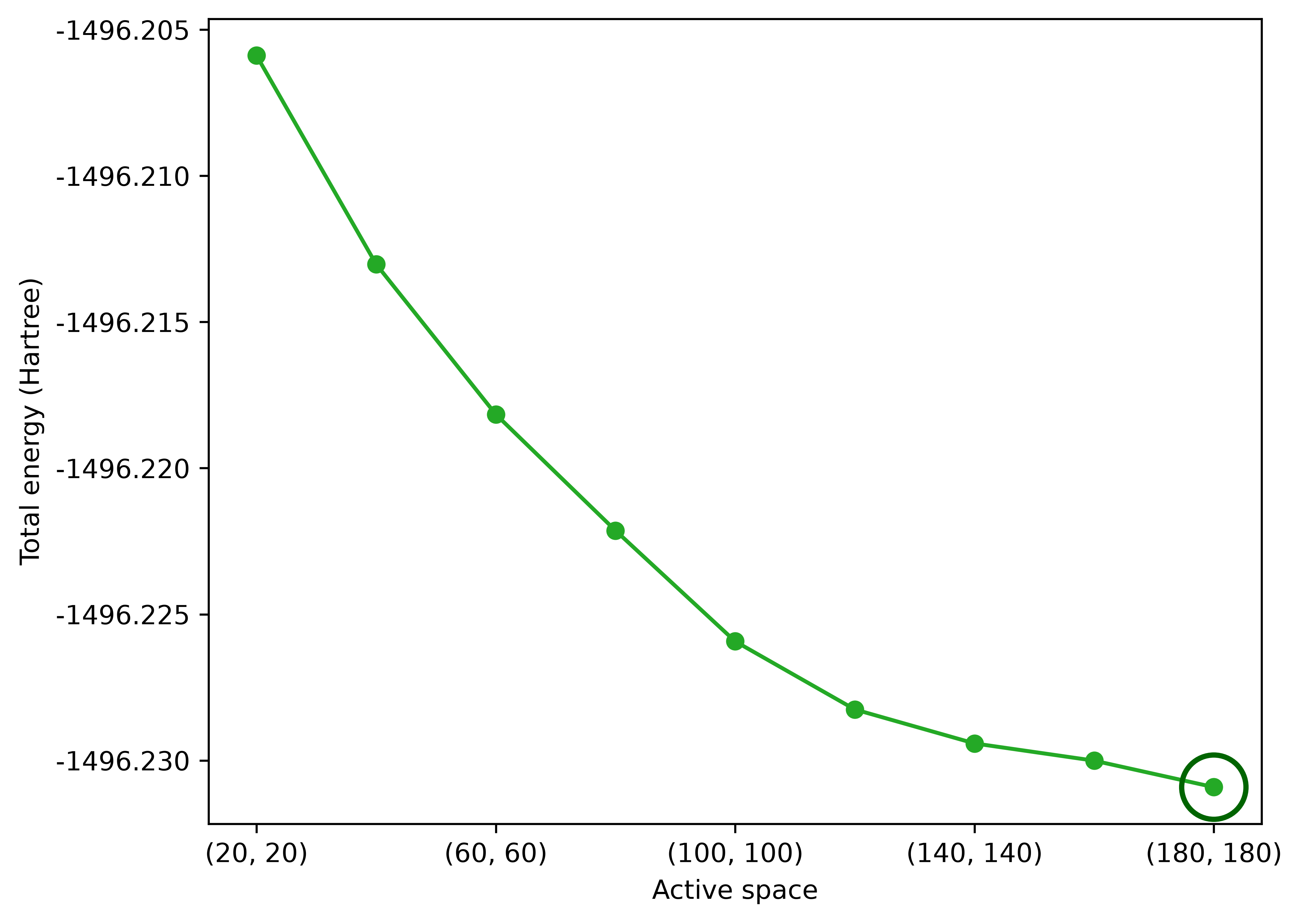
Figure 1. Calculated energy of penicillin V as the active space expands. The highlighted point corresponds to 180 spatial orbitals and 180 active electrons and is the point where HPC became necessary.
We began this exploration on an NVIDIA DGX Spark, our preferred desktop system for rapid quantum application development and prototyping. As we increased the active space, growing memory requirements and runtimes made high-performance computing (HPC) relevant around 180 qubits. Moving to Gefion let us continue at larger scale with shorter turnaround. To see why multiple GPUs help, we need to look at what happens within each calculation.
Why Later Iterations Dominate Total Runtime
Our previous post showed how simulation time grows with qubit count. Here, we follow BEAST-VQE at a fixed qubit count to see how the cost grows as the calculation approaches convergence.
BEAST-VQE adds gates iteratively as it improves its approximation to the molecular ground state. The first circuits are short and quick to simulate, but later iterations become increasingly demanding. The number required depends on the system and accuracy sought; in our experience, convergence typically requires at least as many iterations as qubits, so larger active spaces also mean more iterations.
In the illustrative DGX Spark run in Figure 2, energy estimation accounted for about 99.2% of the final iteration’s runtime, rising to 99.99% with sampling included. Together, these quantum-circuit simulation tasks dominate the expensive later stages and are the natural focus for GPU acceleration.
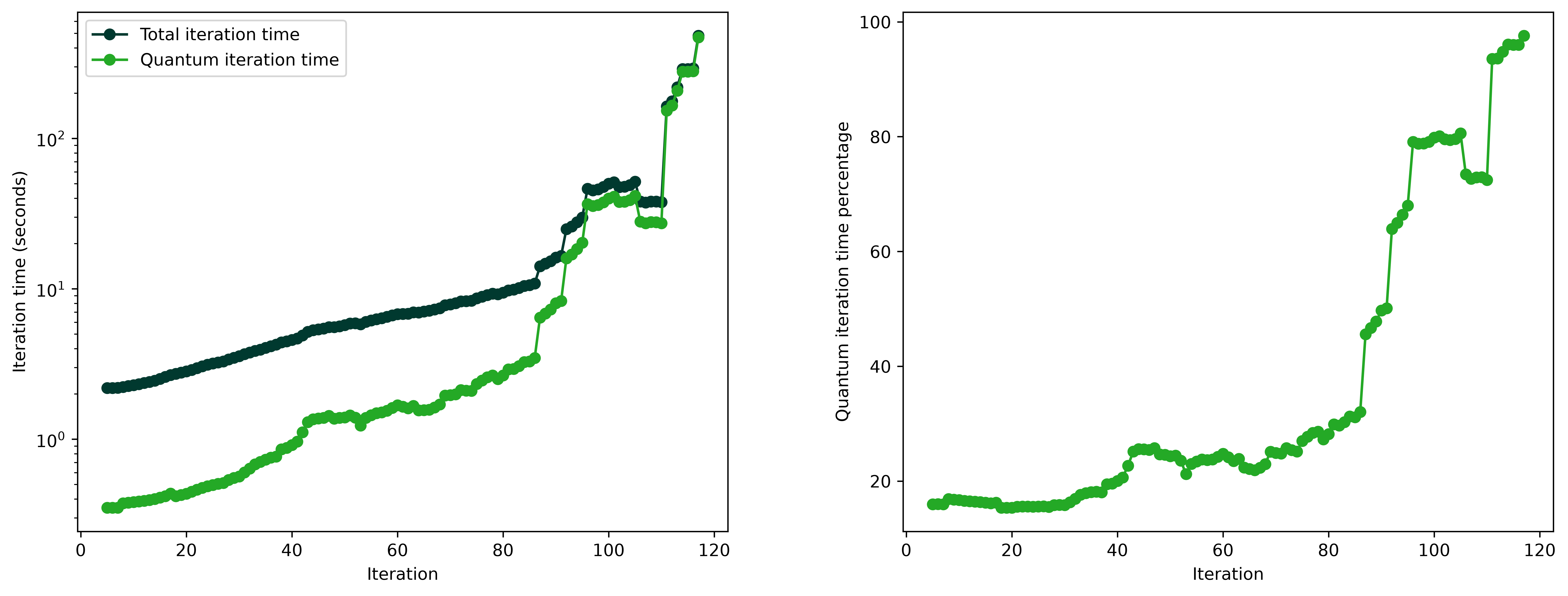
Figure 2. Illustrative BEAST-VQE workstation run. Left: iteration time; right: fraction spent on quantum-circuit simulation. The curves are smoothed to show the trend; individual timings also reflect variation in contraction-path quality.
The early iterations may offer too little work to share efficiently across multiple GPUs, but Figure 2’s logarithmic time scale shows how quickly they pass. For calculations demanding enough to require HPC, the later iterations dominate total runtime, so accelerating those is what matters most for the time to an accurate result.
From Two NVIDIA DGX Sparks to 64 GPUs on Gefion
Following the original post’s outlook, we acquired a second Dell-branded DGX Spark and connected the pair via NVIDIA ConnectX™-7 over 200 Gbit/s Ethernet. We then developed a backend for the MPI version of cuTensorNet, beginning with small end-to-end BEAST-VQE runs before testing fixed 80-qubit circuits and contraction paths. As demanding circuits started finishing in half the time on two Sparks, we were ready for Gefion.
On Gefion we started measuring scaling within a node, proceeding to include internode communication. Initial energy-estimation time for a demanding 80-qubit circuit fell from 36 minutes on one NVIDIA H100 GPU to 4.5 minutes on eight, followed by 73 seconds on 32 GPUs across four nodes. Having measured near-ideal scaling both within and across nodes, we proceeded to extending the size of the active space.
For this purpose, we moved the 180-qubit penicillin V calculation to Gefion and began experimenting with end-to-end ground-state energy calculations on a single node with eight NVIDIA H100 GPUs. As discussed earlier, the total time to solution for such large problems is dominated by the computations of the later iterations. These iterations not only compose the challenging part of the full calculation, but is also the part where quantum circuit simulation consumes almost 100% of the runtime. Earlier iterations offer less work to distribute, so using multiple GPUs from the outset is not necessarily efficient. Slurm job dependencies provide a natural way to accommodate this: start on a single GPU, then resume on multiple GPUs once the calculation becomes sufficiently demanding.
To show how additional GPUs help at that stage, we measure strong scaling for a fixed circuit from a late iteration. Timing complete VQE runs at different GPU counts would mix the benefit of parallel execution with variation in the contraction paths found by the randomized search. It would also include the early iterations, which offer little scope for parallelization. Using a fixed late-iteration circuit lets us isolate how efficiently additional GPUs accelerate the demanding work that motivates the move to HPC in the first place.
The circuit came from iteration 185 and contained 1,940 gates, including 370 CNOTs. We performed energy estimation in single precision (FP32), reusing the same contraction path across all GPU allocations to keep the workload constant.
Doubling the allocation from one to two, four, and eight nodes reduced runtime from slightly over 9.5 minutes on eight H100 GPUs to just under 75 seconds on 64. Figure 3 shows how closely this eightfold increase in GPUs approaches an ideal eightfold reduction in runtime.
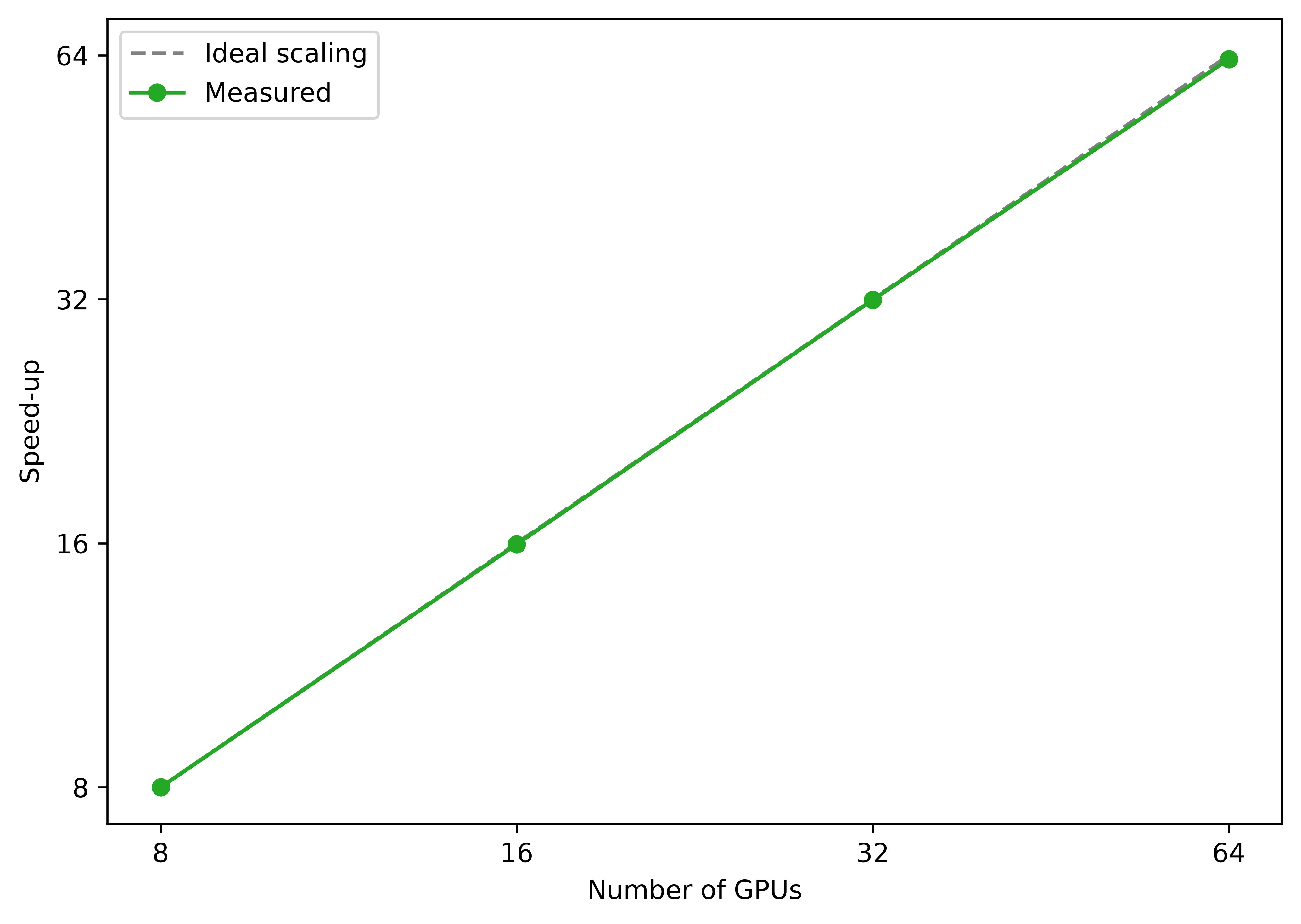
Figure 3. Strong scaling for the fixed 180-qubit BEAST-VQE circuit on Gefion. Speed-up is normalized to the eight-GPU run and multiplied by eight, so ideal scaling follows the GPU count.
Each point represents one energy-estimation call, including contraction, path finding, and autotuning. Finding the reused path took 0.5 seconds, which we add to every timing; autotuning runs independently each time and contributes approximately 2 seconds across the tested GPU allocations. The total 2.5-second preparation cost explains part of the departure from ideal scaling as contraction time falls. Extrapolating from eight GPUs suggests around 80% parallel efficiency on 512 GPUs, assuming ideal contraction scaling and constant preparation time. We have not yet been able to allocate enough Gefion nodes to test this estimate, however.
Putting the Scale in Context
In our initial post, we discuss a study simulating VQE circuits for hydrogen chains with up to 200 qubits on the New Sunway supercomputer. The study also treats larger molecular systems using density matrix embedding theory, and demonstrates scaling beyond 20 million processor cores on a separate, fragmented hydrogen-chain workload. The approaches differ in both their treatment of the physics and their simulation methods: the study’s matrix-product-state simulator limits the bond dimension, which can introduce truncation error, while we avoid that truncation but use a simpler paired-electron model. The reported resource requirements are therefore not directly comparable.
For Qrunch users, the practical significance of our results is much more clear: we provide an easy route from workstation development to distributed execution, which can be followed whenever applications demand greater scale or shorter turnaround.
Beyond Penicillin Towards Modern Drug Discovery
Penicillin has given us a concrete benchmark to drive our initial development, with the longer-term goal of covering the full atomic scale of modern small molecule drugs. To do that without using embedding theory to divide the molecular calculation into smaller parts, we need to keep extending both the size and the quality of the molecular descriptions we can work with.
Penicillin V contains 24 non-hydrogen atoms, while the neutral molecular structure of Eli Lilly’s orforglipron contains 65. This gives a sense of how much larger a modern small molecule drug can be, even before we consider using a richer orbital basis to describe its electrons.
Orforglipron is an oral, non-peptide GLP-1 receptor agonist used in weight management. Understanding how molecules like orforglipron bind to and activate biological receptors is one of the challenges we ultimately want quantum computing applications to help address. Developing and testing those applications at the scale of molecules such as orforglipron will take us well beyond the penicillin benchmark.
Turnaround time matters just as much as molecular scale. We and our customers need molecular systems large enough to address relevant chemical questions, but also calculations fast enough to test ideas, compare results, and refine the approach. Distributed simulation lets that development cycle continue at larger scale while quantum hardware develops towards supporting calculations of this size and beyond.
Bringing Distributed Simulation to Qrunch
In Q4 2026, we will make the configurable multi-GPU simulator backend demonstrated here available in Qrunch for FAST-VQE and BEAST-VQE calculations. Users will be able to select it through the same interface they use for other simulators and physical quantum computers, taking their existing applications onto larger GPU systems as needed. The backend is being tested and validated on NVIDIA DGX Spark and NVIDIA DGX SuperPOD infrastructure via Gefion. Compatible systems must adhere to both Qrunch’s and cuTensorNet’s requirements.
Our aim is to let computing resources follow the chemist’s work, with the same application continuing across different backends. Alongside noise simulation and physical quantum computers, distributed GPUs extend the choices available as users’ questions and accuracy requirements evolve.
Our journey from DGX Spark to Gefion provides us further foundation to extend on. We are in the process of developing a contraction-path finder tailored to the chemistry circuits generated by Qrunch, where better paths can substantially reduce the work required. Combined with NVIDIA-accelerated computing, this should let users go further on a workstation and make more effective use of HPC as they move towards larger drug molecules.
As we extend that capacity, our application scientists are also investigating how these methods perform on practical drug discovery problems. The next step is to connect the speed and scale demonstrated here with the accuracy needed to guide chemical decisions. We look forward to sharing more of those application results.
Try Qrunch Basic now to explore Qrunch and its public showcases, and visit our website for documentation, licensing, and further information.