

Breaking the 13-CNOT Barrier: How AI Agents Helped Optimize a Quantum Circuit
What if reducing just one quantum gate could lead to thousands of fewer operations in a quantum algorithm? At Kvantify, we have demonstrated how AI-assisted optimization can improve a fundamental building block of quantum chemistry algorithms, with potentially significant implications for practical quantum computing.
Published on November 24, 2026
Kvantify Research and Applications
In quantum computing, every gate matters. Quantum gates are the building blocks of quantum algorithms, but they also introduce complexity and potential errors. Reducing the number of gates required to perform a computation is therefore an important step toward making quantum computing more efficient and practical.
This is particularly important in quantum chemistry, where algorithms such as the Variational Quantum Eigensolver (VQE) rely on repeatedly applying fundamental circuit primitives to prepare quantum states.
One such primitive is the double-qubit excitation gate, an important component in quantum state preparation. Until now, its best-known implementation required 13 CNOT gates, a type of two-qubit gate that is particularly important to optimize.
From 13 to 12 CNOT Gates – Why One Gate Matters
Recently we have demonstrated how combining AI agents with mathematical optimization and verification tools can push beyond this established benchmark.
The result is a circuit requiring just 12 CNOT gates instead of 13, while preserving the intended quantum operation.
At first glance, removing a single gate might seem like a modest improvement. But these circuit primitives can be used hundreds or thousands of times when constructing practical quantum chemistry algorithms.
Reducing the CNOT count from 13 to 12 represents a 7.7% reduction for each instance of the building block. Across a large circuit containing thousands of these operations, that translates into thousands of fewer CNOT gates.
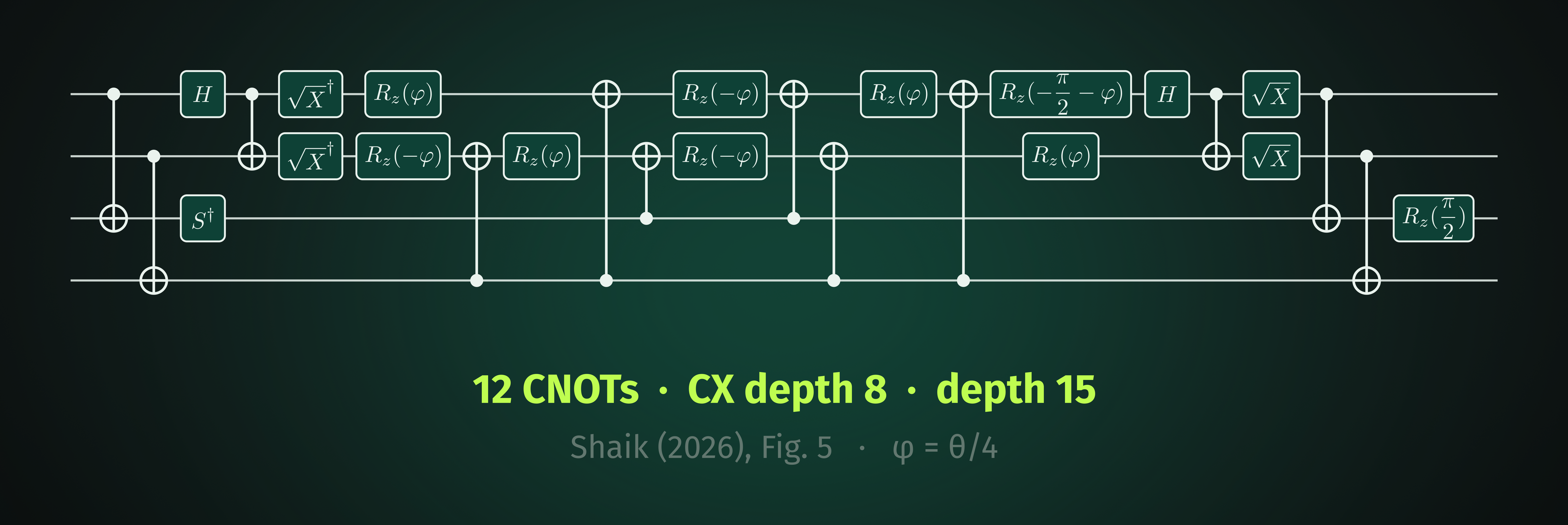
And the improvement goes beyond gate count. The optimized circuit also achieves a substantial reduction in CNOT depth, meaning fewer sequential layers of CNOT operations. This is particularly relevant for quantum hardware platforms where circuit depth is a critical factor in execution efficiency (Fig. 1).
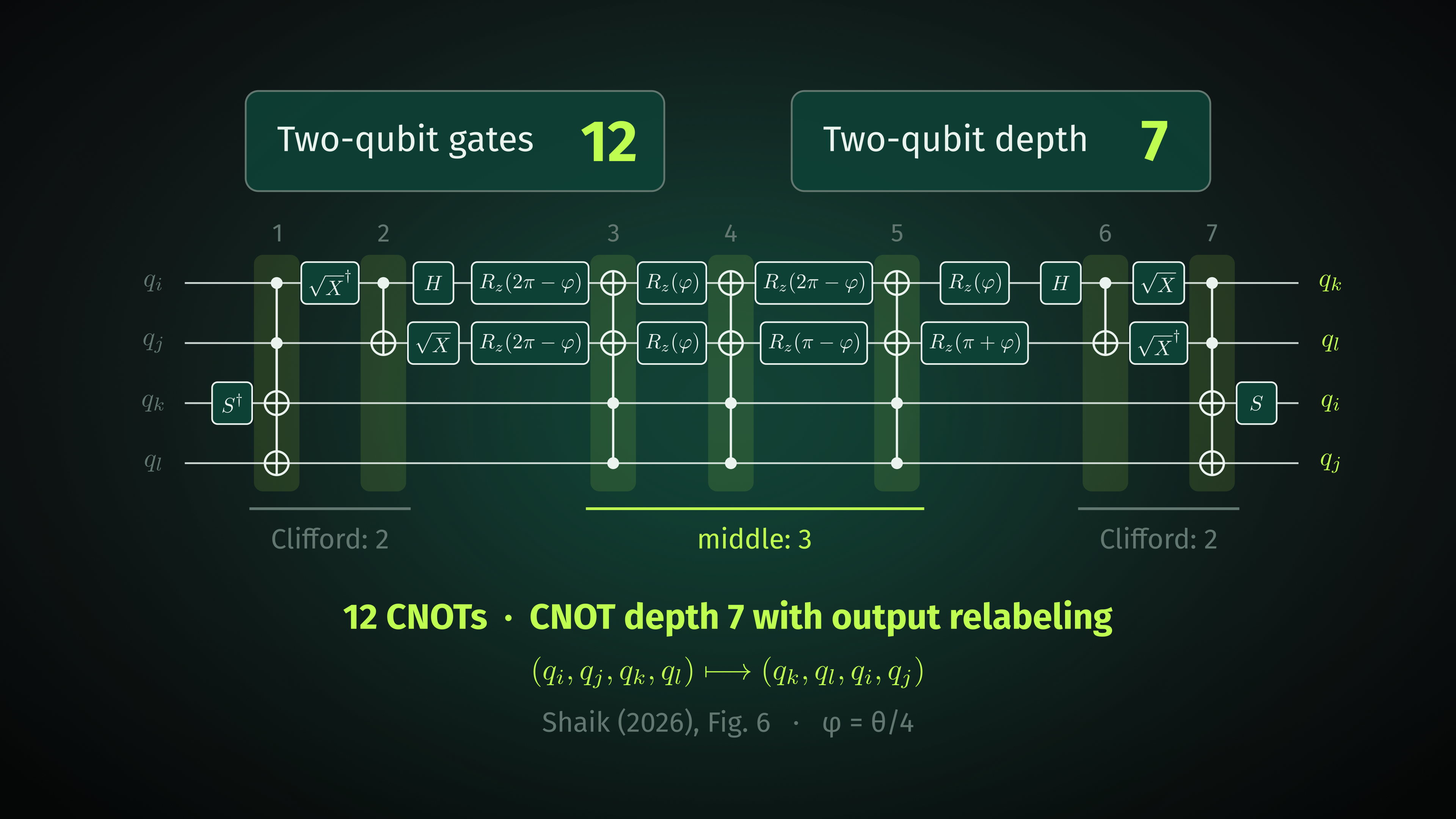
Fig. 1. Optimized double-qubit excitation circuit requiring just 12 CNOT gates and a CNOT depth of 7, demonstrating improvements in both gate count and circuit depth.
AI-Assisted Optimization Opens New Possibilities
Beyond the specific improvements, this work demonstrates the potential of combining AI-driven exploration with rigorous mathematical tools to discover more efficient quantum circuit designs.
Optimizing fundamental building blocks is especially valuable because improvements can be reused across many different algorithms and applications.
At Kvantify, we see this as a promising direction for advancing quantum state preparation and developing more resource-efficient quantum algorithms for chemistry and beyond.
The results were recently presented at the workshop “Quantum Software and Quantum Programming”, organized under the auspices of the Grand Solutions project ODAQS, funded by the Innovation Fund Denmark.
Watch the full technical video to explore how the 13-CNOT barrier was broken and what this approach could mean for the future of quantum circuit optimization:
https://www.kvantify.com/resources/videos/breaking-the-13-cnot-barrier.
Read the paper: Shaik, I. 2026. A 12-CNOT Double Qubit Excitation Gate. arXiv:2608.11733.
https://doi.org/10.48550/arXiv.2608.11733.