

Why Finding the Most Efficient Quantum Circuit Is Harder Than It Looks
How difficult is it to find the most efficient quantum circuit for a given computation? While constructing a circuit that performs the desired operation is often relatively straightforward, finding one that uses the fewest possible quantum gates is a very different challenge. New research from Kvantify establishes a fundamental computational barrier to this task, showing that optimal Clifford circuit synthesis is NP-complete.
Published on November 26, 2026
Kvantify Research and Applications
Quantum computers perform calculations through sequences of quantum gates. Different sequences can implement exactly the same operation, but their resource requirements can vary significantly.
This makes circuit optimization an important part of quantum software development. In particular, minimizing two-qubit gates such as CNOT gates is highly desirable, as these operations generally have higher error rates than single-qubit gates on current quantum hardware.
Clifford circuits, constructed from Hadamard, phase, and CNOT gates, are especially relevant in this context. They appear throughout quantum computing, including in quantum chemistry algorithms, measurement procedures, and quantum error correction.
The challenge is determining just how efficiently a given Clifford operation can be implemented.
Proving That Optimal Circuit Synthesis Is Computationally Hard
In our recent work, we establish that deciding whether a Clifford operator can be implemented using at most a specified number of CNOT gates (but with arbitrarily many single-qubit Clifford gates) is an NP-complete problem.
In practical terms, this means that checking whether a proposed circuit meets a given gate budget is computationally manageable, but finding such a circuit can be fundamentally difficult.
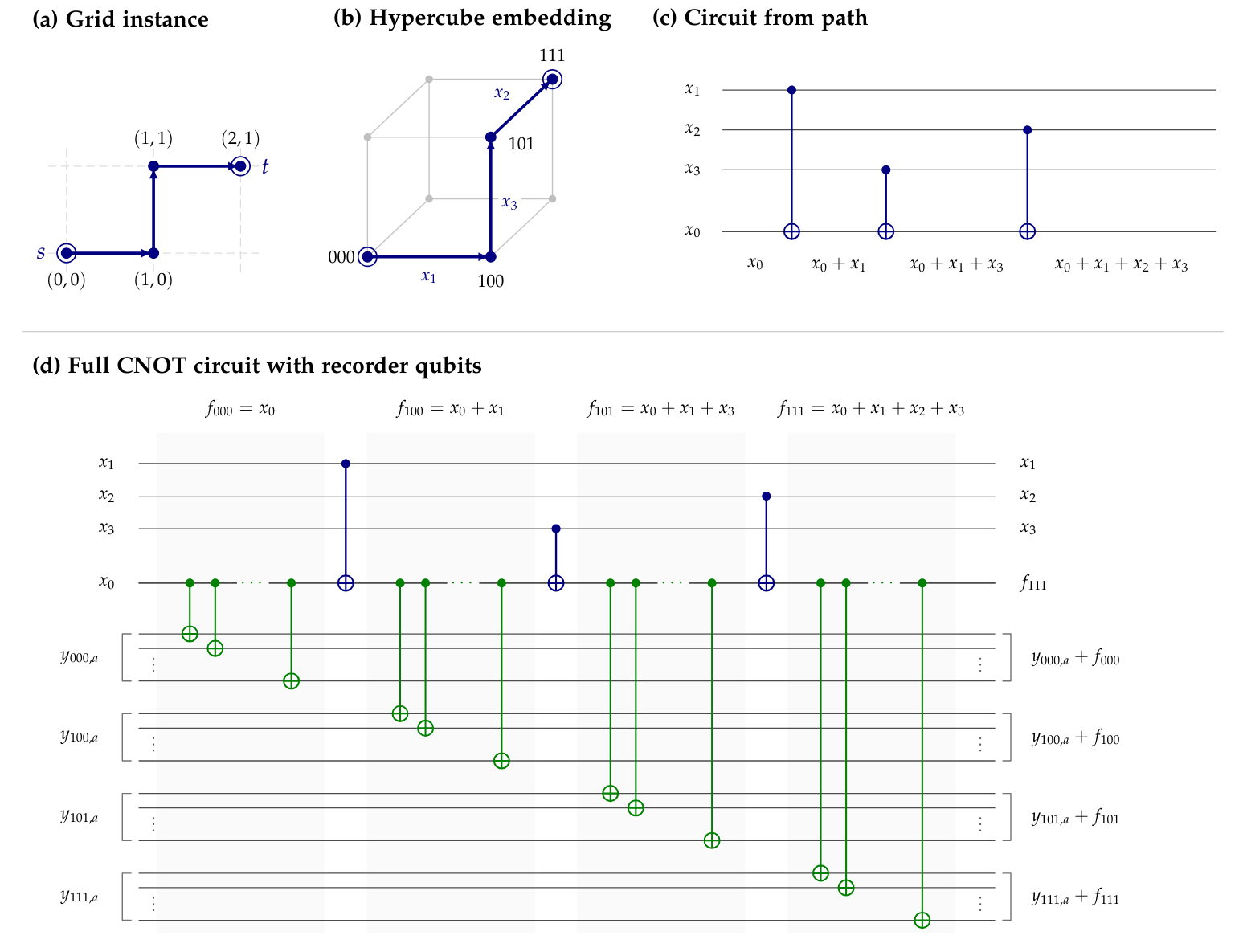
The proof establishes a connection between Clifford circuit synthesis and another well-known NP-complete problem: finding a Hamiltonian path through a grid graph. By translating instances of this path-finding problem into quantum circuit optimization problems (Fig. 1), we demonstrate that solving the latter optimally would also provide a solution to the former.
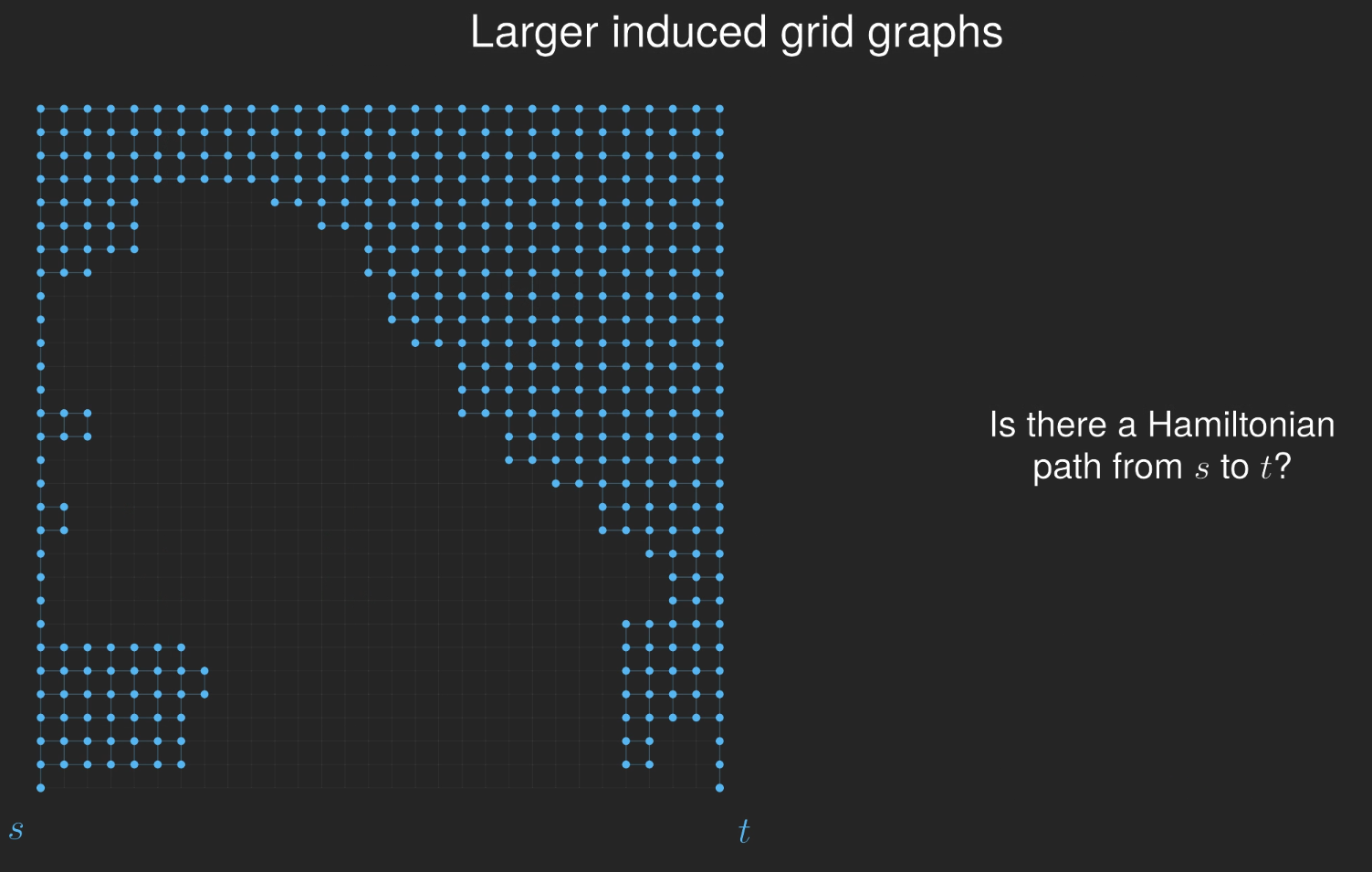
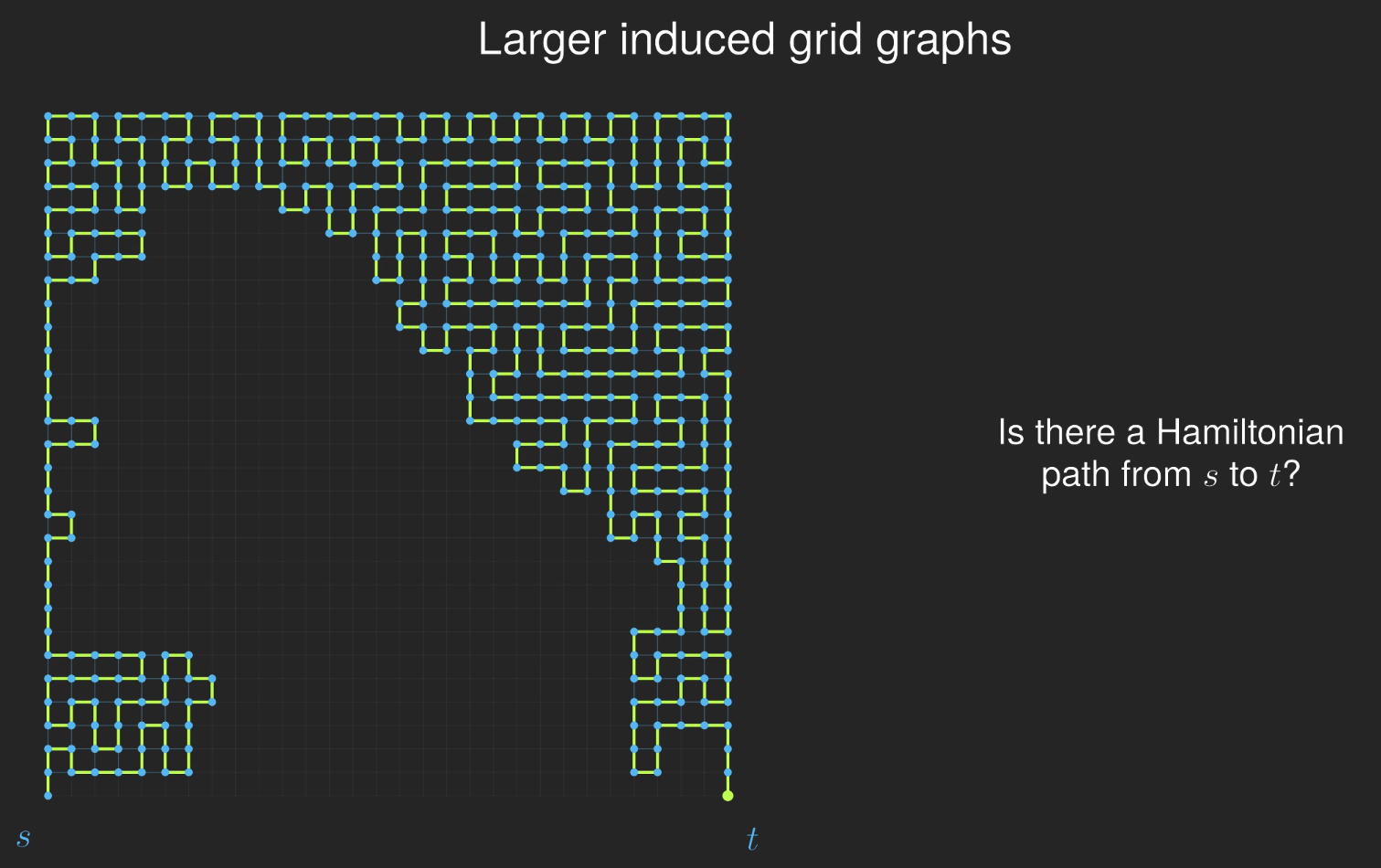
Figure 1. Left: A Hamiltonian path problem instance in an induced grid graph: The task is to go from s to t, moving only along the grid lines. The blue points sit at grid intersections, and each blue point must be visited once, but not more than once. No grid intersections other than the ones marked by blue points can be used. Right: An example of a solution to the problem on the left-hand side.
Importantly, the result holds even for a restricted class of Clifford operators and extends to several more general circuit optimization settings.
This establishes a fundamental limitation: unless P equals NP, no efficient algorithm can guarantee an optimal solution for every possible Clifford circuit.
What This Means for Practical Quantum Computing
The computational difficulty of finding optimal circuits does not mean that meaningful improvements are out of reach.
Clifford circuits frequently appear as smaller components within much larger quantum algorithms. Optimizing these components can reduce the resources needed to execute the complete computation.
One particularly relevant example is quantum chemistry, where algorithms often combine many operations representing molecular processes. Even if each operation has been implemented efficiently, the resulting circuit may still contain opportunities for further optimization.
Clifford circuit optimization is also relevant to quantum measurements. When estimating molecular energies, for example, commuting groups of Pauli operators can be measured together using Clifford circuits. Making these measurement circuits more efficient can reduce the quantum resources required for repeated measurements.
A third application is quantum error correction, where Clifford circuits are used to encode quantum information into error-correcting codes. Efficient implementations are important because these operations form part of the additional computational overhead required for fault-tolerant quantum computing.
From Complexity Theory to Better Optimization Strategies
Establishing that optimal Clifford circuit synthesis is NP-complete has implications beyond the mathematical result itself.
It helps clarify what we can realistically expect from quantum circuit optimization algorithms. While exact optimization remains possible for certain instances, scalable methods must generally rely on heuristics, approximations, or restrictions to particular classes of circuits.
This provides a theoretical foundation for developing optimization strategies that prioritize practical improvements rather than guaranteed optimality.
At Kvantify, this research contributes to our broader efforts to understand and reduce the computational resources required for useful quantum algorithms. By combining theoretical insights with practical optimization methods, we can continue improving quantum software even when finding the mathematically optimal solution is computationally intractable.
Watch the full technical video for a detailed explanation of the NP-completeness proof, the connection to Hamiltonian paths, and the implications for quantum circuit optimization:
https://www.kvantify.com/resources/videos/clifford-synthesis-is-np-complete
Read the paper: Jørgensen, S. F. 2026. Clifford Synthesis is NP-Complete. arXiv:2610.40886.
https://doi.org/10.48550/arXiv.2610.40886