Beyond Affinity: Bringing Residence Time Simulations into Early-Stage Drug Discovery
Published on October 15, 2026
Kvantify Research and Applications
Current Limitations of Kinetics in Drug Discovery
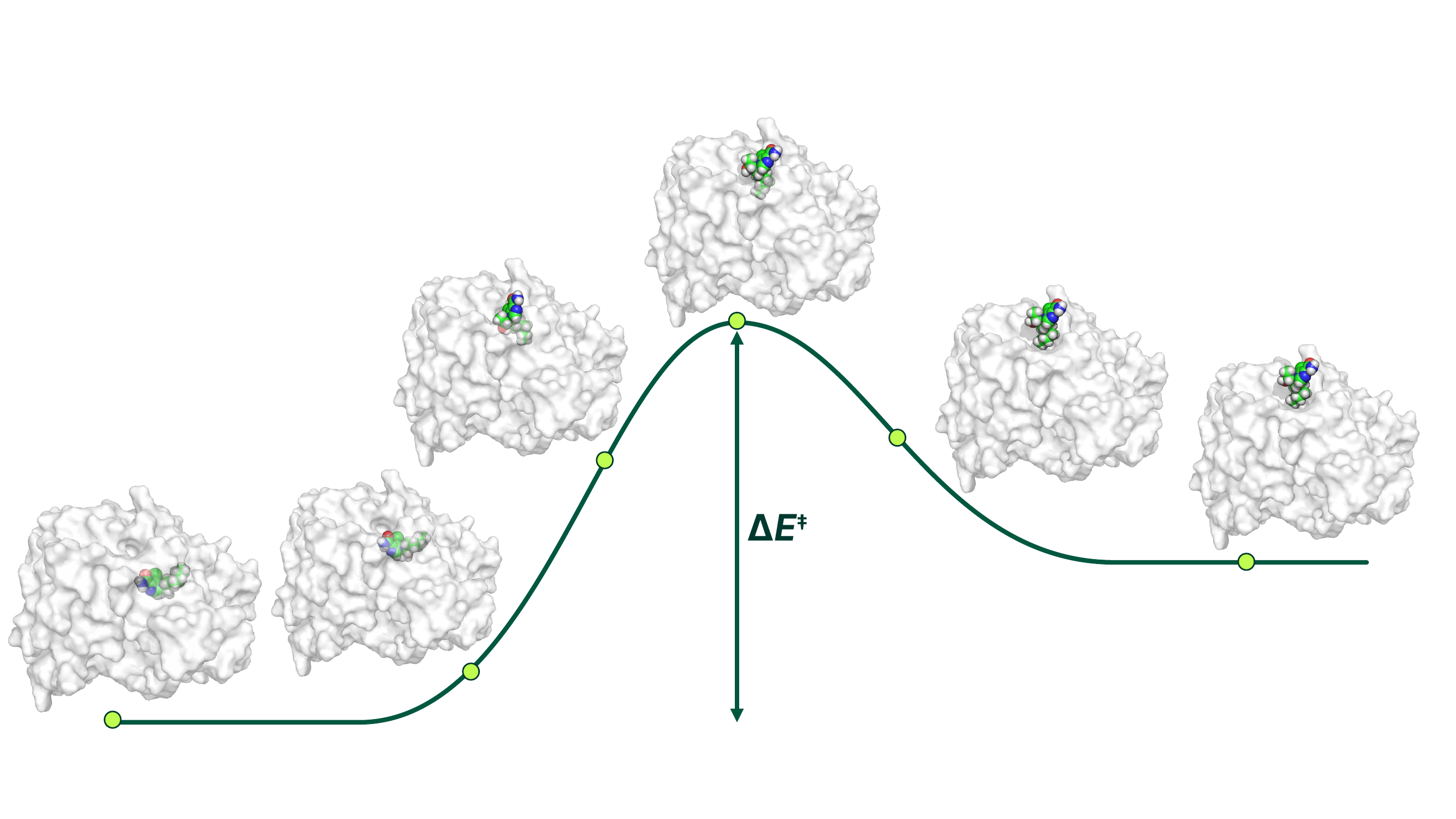
Drug discovery remains time-consuming and expensive with identifying suitable drug molecules still a major challenge. Modern drug discovery pipelines are built around ligand-target binding affinity as a primary endpoint. However, it is well established that knowledge of binding affinity – a measure of binding strength – can be enriched by complementary information from binding kinetics. Historically, binding kinetics has been too expensive and low-throughput to influence early-stage drug discovery. New computational approaches could change that by moving binding kinetics from complex late-stage experiments and calculations to a routine design endpoint embedded throughout preclinical discovery.
Binding affinity is an equilibrium quantity that describes the strength of binding between, for example, a protein and a ligand. Binding kinetics, on the other hand, refers to the dynamics of protein-ligand interactions that underpin binding affinity. This includes both the association of the two components to form a protein-ligand complex (binding) and dissociation of the resulting complex (unbinding). The protein-ligand residence time (often denoted as $\tau$) is the average time that a ligand stays bound to the protein; it can be computed as $\tau = 1/k_{\text{off}}$, where $k_{\text{off}}$ is the rate constant of protein-ligand unbinding. Residence times can range from fractions of a second to hours, or even days in extreme cases.
This means that residence time can become an important consideration when we consider the typical half-lives of therapeutic compounds in the human body. In practice, a longer residence time is indicative of more sustained target engagement for a given dose. A long residence time might support maintained target engagement in a beneficial way, but long residence times may also contribute to undesirable interactions with off-targets. It is not always the case that a longer residence time is inherently desirable. In practice, residence time effects have been noted to affect drug efficacy and induce ADMET liabilities;1,2 these issues could not be rationalized by binding affinity measurements in isolation. While kinetics can provide program-defining efficacy and ADMET insights, it can only be applied at low-throughput so its impact is limited to the later stages of the drug discovery process. By this point, kinetics-driven scaffold liabilities could have emerged in important lead series, which would have to be mitigated for in late-stage optimization after significant investments have already been made. Late-stage chemical modification of lead compounds is also often challenging in itself, requiring the development of bespoke synthetic methods and strategies. Early detection of kinetics-driven liabilities could therefore provide a valuable mitigation strategy.
Computational Binding Affinity and Binding Kinetics: An Imbalance in Progress
Various molecular simulation approaches for binding affinity have matured over the past decade, spanning a range of methods from fast approximate scoring via docking and cofolding methods through to more accurate (and significantly more computationally expensive) free energy perturbation (FEP) calculations. This progress has been driven by wide-ranging open-source and academic projects as well as significant commercially driven efforts. Most binding affinity tools can be applied to any ligand-target complex; however, no approach works well on every target and every compound series.3,4 It is also notable the field is still missing reliable methods to occupy the rescoring gap between very cheap but approximate scoring (like docking and cofolding) and rigorous but expensive protein-ligand binding free-energy calculations.3
Kvantify attended the CECAM 2025 workshop on Predicting and understanding drug-target binding kinetics via molecular simulations, which discussed different computational approaches to the protein-ligand binding kinetics problem and the associated bottlenecks to their development. Progress has been hindered historically by a number of factors, which were discussed in a paper summarizing the workshop by Wolf et al.5 Workshop participants from academia and industry agreed that the lack of high-quality benchmark datasets makes developing and validating kinetics computational methods challenging. There has been an absence of standardized public datasets and blind challenges to drive method development in contrast to binding affinity, where standardized datasets and blind prediction challenges are an established part of the development landscape. While the EV-A71 2A OpenBind release has been rightly welcomed by the computational kinetics community,6 most high-quality ligand kinetics data exists hidden in private commercial datasets. This means that the development of new approaches to ligand kinetics will likely require extensive collaboration between method developers (in academia and industry) and pharmaceutical companies with access to significant proprietary data resources. More high-quality data is required to demonstrate that residence time simulations can provide a valuable computational strategy to modern drug discovery.
Furthermore, simulating protein-ligand unbinding is a huge technical challenge given the long timescales at play (ligand residence times can range from sub-seconds to hours, or even days in extreme cases). While binding affinity deals with equilibrium states of bound and unbound complexes, to tackle the problem of protein-ligand kinetics a computer simulation must meaningfully connect the bound state to the transition state to account for molecular changes that might occur along the way. The elegant alchemical thermodynamics that underpins modern free energy calculations cannot be applied in the same manner here, which makes simulation methods for binding kinetics all the more challenging to develop.
In recent years, the field has observed more traction in methods development despite these hindrances. Various new advances ranging from protocols aiming to predict absolute residence times to faster approximations to relative residence time predictions have been reported.7–9 However, a key conclusion from the CECAM 2025 workshop was that despite recent progress, existing computational methods for protein-ligand residence time estimation are not yet robust enough for routine use in drug discovery.5 So, the prospect of making discovery campaigns kinetics-enabled at an early stage remains unfulfilled in the present day.
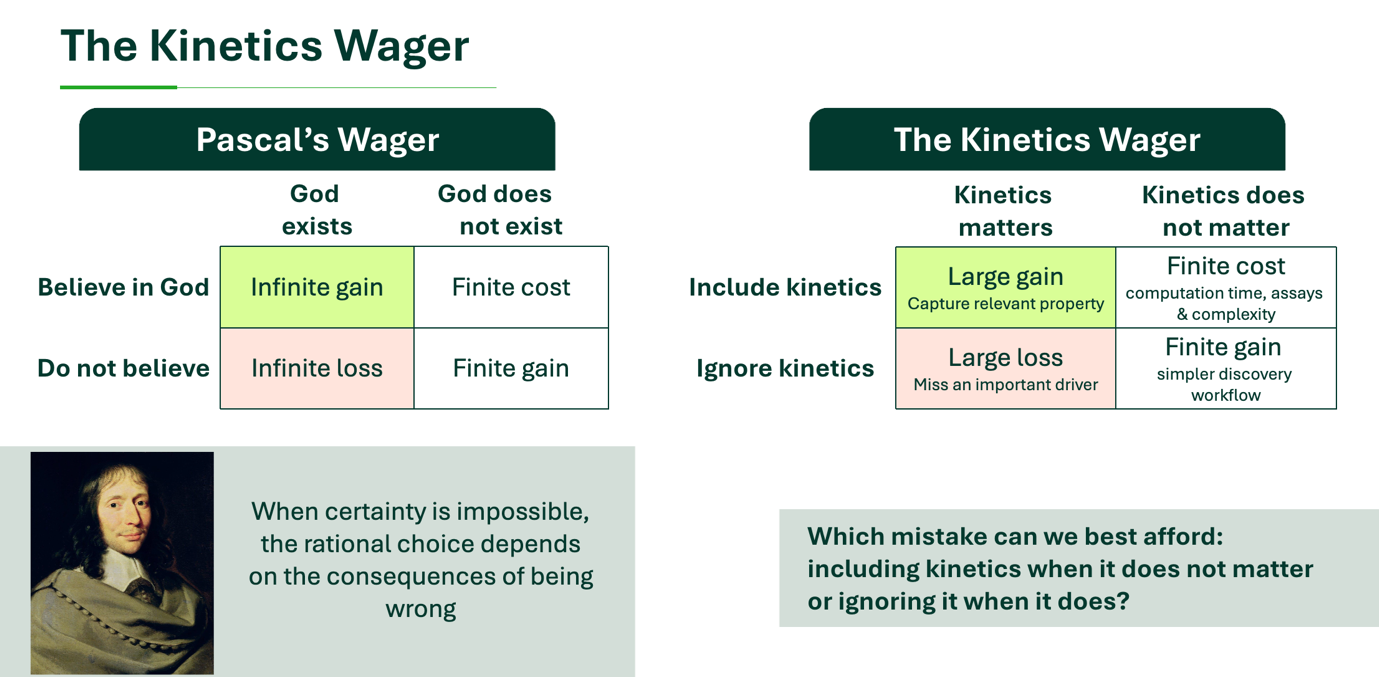
Pascal argued that to believe in God is the rational choice since the potential reward of eternal salvation vastly outweighs the finite cost of belief should God exist. The same logic could be applied here to kinetics simulations: if residence time could be predicted easily and inexpensively during early-stage drug discovery, the cost of doing so would be small compared with the cost of discovering a kinetics-related problem in a lead series at a later stage of development.
High-Throughput Computational Kinetics Methods Could Open New Directions in Computational Drug Discovery
In our recent publication,10 we introduced our solution to the computational residence time problem, Koffee Unbinding Kinetics. We show benchmarking results on hundreds of complexes showing that Koffee Unbinding Kinetics works effectively over a range of targets and ligand chemistries with comparable predictive accuracy to far more computationally expensive techniques. We developed Koffee Unbinding Kinetics in response to the high computational expense of MD-based methods for predicting protein-ligand residence times with the aim of making drug discovery kinetics-enabled at a much earlier stage of development.
Our approach is conceptually different: instead of building on MD simulations via enhanced sampling, we reformulated the protein-ligand unbinding process into an optimization problem. This introduces some new approximations: we model the unbinding dynamics using an energy-only formulation without explicitly simulating the full entropic effects to massively speed up the simulations. Typically, MD-based enhanced sampling simulations take hours (or even days) of GPU time per complex and require manual setup steps that introduce additional latency into the equation. Koffee Unbinding Kinetics is a fully automated, end-to-end solution that runs in approximately 1-2 GPU minutes per complex. This represents a speed up of between 3-5 orders of magnitude with no reliance on training data, unlike machine learning approaches, finetuning or per-target calibration.
While kinetics experiments and current MD-based simulation approaches must sit later in the drug discovery process given their inherent low-throughput and high cost, Koffee Unbinding Kinetics can screen 1000s of compounds on a single GPU in a single day. Koffee Unbinding Kinetics is therefore applicable to large-scale tasks typical of virtual screening campaigns in early-stage drug discovery. We have been testing Koffee Unbinding Kinetics on high-throughput tasks such as virtual screening rescoring, combination scoring with docking, and pose selection. We are currently exploring these new high-throughput capabilities with industry partners to further develop Koffee Unbinding Kinetics and unlock its full value to computational drug discovery.
Given its massive scalability, Koffee Unbinding Kinetics allows us to think about exploiting the Kinetics Wager. By routinely applying residence time predictions to computational drug discovery pipelines, we can move to mitigate kinetics-based liabilities early in the discovery process.
References
- Bernetti, M.; Masetti, M.; Rocchia, W.; Cavalli, A. Kinetics of Drug Binding and Residence Time. Annual Review of Physical Chemistry, 2019, 70, 143–171.
- Qiao, H.; Yuan, Z.; Xing, L.; He, B.-X.; Ma, L.-Y.; He, Z.-X. Innovative Medicinal Chemistry Strategies for Improving Target Binding Kinetics in Drug Discovery. Journal of Medicinal Chemistry, 2025, 68, 22116–22144.
- Sindt, F.; Bret, G.; Rognan, D. On the Difficulty to Rescore Hits from Ultralarge Docking Screens. Journal of Chemical Information and Modeling, 2025, 65, 5553–5566.
- Schindler, C.E.M.; Baumann, H.; et al. Large-Scale Assessment of Binding Free Energy Calculations in Active Drug Discovery Projects. Journal of Chemical Information and Modeling, 2020, 60, 5457–5474.
- Wolf, S.; Bottegoni, G.; Nunes-Alves, A.; Wade, R.C. Where do we go from here? Current state of drug–target binding kinetics and a roadmap to their establishment in drug discovery campaigns. Drug Discovery Today, 2026, 31, 104704.
- EV-A71 2A OpenBind Release: Affinity and kinetics data.
- Ojha, A.A.; Votapka, L.W.; Dutta, S.; Noland, A.F.; Hanson, S.M.; Amaro, R.E. seekrflow: Towards an End-to-End Automated Simulation Pipeline with Machine-Learned Force Fields for Accelerated Drug-Target Kinetic and Thermodynamic Predictions. Journal of Chemical Theory and Computation, 2026, 22, 6941–6960.
- Smith, Z.; Branduardi, D.; Lupyan, D.; D’Arrigo, G.; Tiwary, P.; Wang, L.; Krilov, G. Toward Automated Physics-Based Absolute Drug Residence Time Predictions. Journal of Chemical Information and Modeling, 2025, 65, 13360–13373.
- Sinko, W.; Mertz, B.; Shimizu, T.; Takahashi, T.; Terada, Y.; Kimura, S.R. ModBind, a Rapid Simulation-Based Predictor of Ligand Binding and Off-Rates. Journal of Chemical Information and Modeling, 2025, 65, 265–274.
- Madsen, N.K.; Ziolek, R.M.; et al. Journal of Chemical Information and Modeling, 2026, 66, 11377–11388.